Wednesday, June 7, 2017

Preventing Pet Pudginess


Doug’s Dog’s Diet

“Your dog is too fat,” our veterinarian told me…well, stated a bit more diplomatically than that.

Shocked, I asked him how one could tell, “You should see she has a waist.” True, by that standard, Colette, our part-Chow, part-Retriever rescued dog was a bit chubby, about ten pounds (10 lb) heavier than she had been when we got her at age three, back in June of 2014, two years earlier. She was thick around the middle, not thin.

We had bonded the day we got her, with this usually shy dog putting her head on my thigh as I drove her back from the dog van, piloted by Tennesseans who rescued her from the dog pound. 

We didn’t want her to go hungry at home.

We fed her, as recommended, two cups of dry food, one of canned, a total of about 1000 Calories per day (Cal/day), half that of a typical human. She would not accept treats offered to her, so her intake was well controlled.

Unfortunately, she was to join the nearly 60% of dogs and cats who are overweight, according to the American Animal Hospital Association. The implications are the same as for humans. We are “killing our pets with kindness,” by over-feeding them.

Two simple mathematical relationships are keys to weight control, for pets and people. 


Average Weight

Averaged over a few months, our weight tends to be given by the following relationship:

W = C / A

Weight (lb) = Caloric Intake (Cal/day) / Activity (Cal/day per lb) 

My quadriplegic wife gets 1300 Cal/day and for her, A=10, leading to an average weight of 130 lb. More active people will have larger values of A.

The beauty of the relationship is that you do not even need to know your activity level, A, a mix of resting metabolism and energy expended in motion. You can decrease Calorie consumption and predict its impact on weight, using a second relationship.


A Second Relationship

The Caloric value of a pound of fat, on us or in our food, is:

1 lb fat = 3600 Cal.

To lose a pound of fat through dietary change alone requires foregoing 3600 Cal. Two slices of bread equals almost 200 Cal. Just that little change daily can produce almost two pounds per month (6000 Calories) weight loss initially.

Eventually, the weight loss stops, and you reach your new long-term average.

If you change your eating habits by just 200 Cal/day, and if you usually consume 2000 Cal/day, our first relationship tells us you can expect to change your long-term average weight to 90% of what it is now, because your caloric intake will be 90% of what it was, a 10% decrease. For me when I was at 160 lb, that would mean 

(0.90)(160 lb)=144 lb.


Colette and I Go on a Diet

So, to get to be approximately 10% less heavy in the long-run, we need to cut our average Calorie intake by 10%. Often this is easier than trying to get a significant, sustained increase in our activity levels, A.

For example, for me to walk a mile in 20 minutes would consume only about 80 Cal, (https://www.verywell.com/walking-Calories-burned-by-miles-3887154), which is contained in one slice of bread.  My daily Calorie expenditure is probably 2000. Increasing that expenditure 10% would be 200 Calories, 2.5 miles of added walking, 2.5 slices of bread.

At about the same time Colette joined us, I found I weighed 160 lb, looking a big chubby. That continued about half a year; then, in May 2015, I decided not to go on a diet but to change my eating habits permanently, because a diet would produce only a temporary change in weight.

The major change I made was to cut out starchy food, such as baked goods, potatoes, rice; breakfast became an instant breakfast drink with an added scoop of dry non-fat milk, and I had another such drink in the evening. Lunch was salad, cheese or meat, and juice. Dinner was much like lunch, with more meat, and salad or veggies and juice. The rather high protein intake led to my rarely feeling hungry, and if I did, I had some nuts.

To reduce Colette’s pudge, I shifted her from about 1000 Cal/day to approximately 600 Cal/day, a rather drastic cut. I had intended to cut it by 20% but miscalculated.  On the next vet visit, her weight had dropped to about 52 lbs, and she looked quite good, so I restored some of her calories, 1.5 cups of 
dry food and a cup of canned food, about 800 Cal/day, where it stands now. 

She may still be losing a bit of weight, but not much.

In five months, as had Colette, I hit my target weight, 145 lb., a 10% reduction, and I’ve maintained it, or lower, for the following 20 months.


It’s Easier with a Dog

Granted, it is easier to control a dog’s diet and exercise than our own. Colette did not need Jenny Craig, Weight Watchers, Atkins, NutriSystem, with their enticing prospects of get-slim-quick yummy meals. I provided her with disciplined resolution. Her daily exercise was rarely varied, too, making it easy to compare one diet with the next.


The Bottom Line

The good news is that a sustained change in eating habits can produce a sustained change in weight. No complex programs or exotic food choices are needed.


The key is to make a dietary change you can stick to, a change you can live with, a change that will improve your life...or the life of your pet, true for mice and men, dogs and Dougs.


###

Douglas Winslow Cooper, Ph.D., is a semi-retired physicist who now helps people write and publish their books through his http://WriteYourBookWithMe.com.

Monday, June 5, 2017

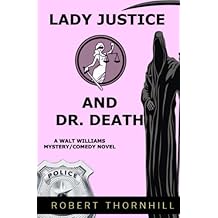
Review: LADY JUSTICE AND DR. DEATH

Product Details

This interesting book is not quite an even-handed look at euthanasia. The cards are stacked in favor of "death with dignity."

First, let me give author Thornhill his due: the characters are complex and worth knowing, the plot proceeds logically and satisfyingly, the ending makes sense. He writes well, albeit with thumb and one finger. The other reviewers have given him 5 stars, "love it."

I like my heroes a bit more attractive than a randy  sixty-five-year-old, even though I myself am in my seventies, or perhaps because I am in my seventies. Still, Walt Williams is a fine man, a thoughtful man, and he and his partner, Ox, work well together, with Ox supplying the needed muscle.

So, euthanasia: we have enough morphine to kill pain, and I am not opposed to using it even to the extent it risks the patient's life, instructions I gave her doctors 13 years ago when my wife, newly quadriplegic and placed on a ventilator permanently, was fighting for her life after a near-fatal aspiration due to her multiple sclerosis. When she emerged from her therapeutic coma, she was glad I had reversed her instructions that precluded heroic efforts to save her life. 

Before the crisis, you think you know what you want, but you cannot really know. During the life-threatening crisis, you are distracted or incompetent to to make a rational, informed decision, and only afterwards do you have a knowledge of what happened and what resulted, and how you feel about what was done.

If you are going to sign a Living Will, an Advanced Directive about how much effort should be expended on saving your life, be very cautious: you do not know what your future will be. Patients with DNR (Do Not Resuscitate) instructions are given less good care, my wife's nurses tell us, despite the denials of medical institutions.

Patients who are capable of committing suicide and want to, should be allowed to do so, though discouraged from carrying it out. It is hard to see morality in not taking your own life, as there are many relatively painless ways to do it, but asking someone else to kill you.

For the near-total disability of ALS, for example, the issue is progressive loss of capability, and the "answer" is to help such patients with technology to gain something of worth in living each day, "the plan is to enjoy what you can." Sadly, the patient will reach a stage where nothing can be enjoyed and he is unable to take his own life. Not every ethical has a solution. The patient should be given our compassion and admiration for fighting the good fight to the end.

I will likely read another of the Lady Justice series, despite my reservations about this novel.

Sunday, June 4, 2017

RETIREMENT? NO, REFIREMENT!, Sec. 4 Health


RETIREMENT? NO, REFIREMENT!: Beyond just surviving, your continuing survival by [Wamala, Petero, Cooper, Douglas]


Section 4

Health
“In life lots of people know what to do, but few people actually do what they know. Knowing is not enough! You must take action.”
Anthony Robbins


Hard Facts

Please don’t make the mistake of thinking this section doesn’t apply to you; either you have already been affected by the issues mentioned below, or you have the luxury of inoculating yourself against them.

Either way, we have a battle on our hands. Not an explosive one, and maybe not one that will award us any medals - rather a battle of strategy and quiet discipline.

We understand that retaining is an unattractive concept compared to attaining, but those are the new terms of the battle, and the quicker you can accept those terms, the better prepared you will be.

A correlation has been noted between aging satisfaction and the use of preventative medical services [13]

Consider the Activities of Daily Living -

ADLs - Activities of Daily Life
IADLs - Instrumental Activities of Daily Life
Having a bath or shower
Doing routine housework or laundry
Using the toilet
Shopping for food
Getting up and down stairs
Getting out of the house
Getting around indoors
Doing paperwork or paying bills
Dressing and undressing

Getting in and out of bed

Washing face or hands

Eating, including cutting up food

Taking medicine

Source: Health Survey for England 2015 Adult social care

21% of men and 30% of women aged 65 and over needed help with at least one Activity of Daily Living (ADL), and the percentages are slightly higher for the second column.
[21] From this point, difficulties increase with age.

Functional impairment comes from a variety of sources - the onset of Alzheimer’s, arthritis, falls, etc.

Fighting Back

Note - Any exercise programme should, of course, always first be discussed with one’s health care provider.

No group can benefit more than older persons from regularly performed exercise. [3]

Research shows that strength training is needed to both stop or reverse sarcopenia—the body’s loss of protein as one ages —and to improve bone density. For the elderly, increased muscular strength is a pivotal factor in maintaining health and independence. Two to three days a week, with a day of rest between workouts, is recommended to maintain bone and muscle strength.

Aerobic exercise has long been shown to prevent and treat many of the chronic, age-associated diseases, including heart disease, hypertension, and osteoporosis. Older persons should build up to at least 30 minutes of aerobic exercise—for example, walking, swimming, aqua gym and stationary cycling—on most, if not all, days.

Protecting Mobility

One of the greatest dangers to our autonomy is losing balance, stability and range of motion; exercise programmes must be designed with the specific purpose of improving balance - not just increasing your level of activity.

Stability, even for the young, is an often neglected component of fitness. Often when people go to the gym they want to inflate certain muscles that they feel attractive but that in some cases have no functional point, and want to jump onto one of the fancy looking machines, which actually restrain movements into a linear motion,

Stability puts off some people, because:

1.   It’s difficult to train (although more effective.)
2.   The visual effect that it has on your physique is less pronounced.
3.   You might feel a bit silly wobbling about in tricky positions.

Yet converts to stability training quickly become its advocates and wish that they had started sooner; this is something that practically all human beings should do, old or young. When you actually talk to a fitness trainer, or ask them how they, or athletes, train, they’ll tell you bypass 90% of the equipment at the gym and go straight for the mats, the large inflatable balls, the free weights, and the Bosu®.  (Essentially a hemisphere which is difficult to balance upon.)

All of which can be purchased for home use, relatively cheaply, and a solid work-out needn’t last longer than fifteen minutes, and needn’t even cause you to break a sweat.

Once you have a routine you must stick to it, or else you will lose the benefits you have gained. [14,]

As always, when it comes to sticking to a routine automate it. Set an alarm!

Heart Health

A healthy lifestyle is the alpha and omega of looking after your heart. By all means avoid smoking. This is one of the best gifts you can give your heart. Regularly check your blood pressure and cholesterol levels Regularly check for diabetes. Break the sweat at least twice a week through exercise. Personally, I took up squash at age 56 ! Thrice a week, I am at the squash court, not playing competitive squash, but playing nevertheless, and getting the mother of all workouts.

Know your body mass index, and ensure you maintain healthy weight. Watch your diet and try to minimise salt. Avoid fatty foods, and make fruits and vegetables part of your routine diet. Now I hope my long-time friend, Dr. Alex, never reads what I am going to say next!!

However I have to, must say this: limit alcohol intake. Truth is, I love my beer and I am trying all I can to reduce significantly, with mixed success! Plus for 45 days every year, I totally abstain from beer. Dr. Alex, did you read that? Times are changing, and even yours truly is changing. Did I mention that the Australian-trained Dr. Alex still puffs a cigarette or two?

And so it goes on, Dr. Alex telling me not to sip a beer and me chiding him not to puff a cigarette! What is the point I am making? In matters of personal indiscretions, let us face it addictions, only dear friends you trust, dare look you straight in the eye, and say: “STOP IT “


Mental Health

Research on the effects of retirement on mental health provides widely varying results [6] and the trend appears to be based on the work environment you’re leaving.

Statistically speaking, retirement has been shown to correlate with depression [15]
Late Life Depression is a real, and distinct thing, LLD.
Depression is a vicious circle to whomever it affects - as is demotivates sufferers from seeking help. This is especially dangerous the elderly, for whom medical and social support become increasingly important. [15]


###

This is the continuation of a weekly serialization of this new ebook on active retirement, by Wamala and Cooper, which book is available through amazon.com for $0.99: 

Sunday, May 21, 2017

FRUSTRATED WITH LIFE? Ch. 4 Family


“All that we love deeply becomes part of us.”
Helen Keller


“Positive feelings come from being honest about yourself and accepting your personality, and physical characteristics, warts and all; and, from belonging to a family that accepts you without question.”
 Willard Scott


FAMILY Statistic:

For children 17 and younger: only 46% live in the traditional family, with both parents in their first marriage; 15% have two parents , one or both remarried; 34% live with a  single parent; 5% have no parent at home. [Pew Research Center, 2014]

Chapter 4:
Family


Family members can be our best allies, but too often they hurt us instead. We marry in passion and sometimes regret soon after. Children are born, wanted or not, and they know it. We don’t ask to be born; it is an unintended gift that we unwrap over our lifetimes. As parents, we try to do what is right, but circumstances intervene, and our children become puzzles to us, and we to them.

One blogger characterizes kids as “walking headaches.” Another is appalled by their casual free-loading, rarely helping out. A mother calls her son a “retard.” These pale compared to a girl’s being raped by her eldest brother. One writer would commit suicide but doesn’t want the parents to lose their only child. Another is pregnant with the child of her sister’s husband; she is continuing the infidelity. Just say no!

The family to which we are born determines our genes and early environment,  so we are molded by “nature and nurture” to be a lot like them, yet often that is not enough to keep us loving them…and them loving us. Sometimes, we must decide that staying close to them is a losing proposition.

While marriage can provide enormous joy and solid support, when it goes bad, we have an “intimate enemy” inside our emotional walls, and Heaven becomes Hell. Again, we have to change what we can, move on if we cannot. 

Douglas Winslow Cooper, Ph.D.

#11
My wife keeps telling me that I say things when I know I didn't...I think she's going deaf and only hears what she wants to hear.

#17
my kids don't listen, what happened to being able to spank your rotten kids without getting thrown in jail.

#20
My family recently sued me for stealing a domain name that expired. Luckily they sued me in court on national TV, and now I have more visitors then ever! Things couldn't have worked out better if they were staged...

#47
Kids... teen boy thinks he's an adult, tween girl lacking self discipline. All I do is reinforce the Same thing they've heard all their life. I am stressed and ready to be free from parenting...walking headsaches. Tell know children are a blessing some are barren. This is truly building patience.

#50
I have a man that is slower than molasses, I am constantly reinforcing things to my kid, that we've talked about for years. I fed up with mundane living...its like the movie groundhog day. I push my self to achieve and work hard, I just wish my family would buy a clue. They make me feel like I need drugs to cope...or at least zone out.

#61
How do you ask your adult children (3 of them) to help out financially? While I love that they all came back home after college, they still act like kids. They all have jobs but they eat for free, live here for free, do nothing to contribute around the house, they use my car and use up my gas without even refilling. It is becoming a burden to take care of everyone on a fixed income (I am a single mother on permanent disability from a work related injury). I have asked them to pitch in in a round about way but I get no response, please help!

#66
I'm frustrated w my husband n his job. We hv two small kids n althought I work all week long plus overtime, when the weekend comes I want to relax but since he works during the weekend I get no 'me' time. I've asked him over n over to change his hours to be home more during the weekend, he feels this is best to help save money n be w the boys during the week. So tired of being the one always getting the short end of the stick. Screaming on the inside.


#67
I hate my oldest brother! he rape me when I'm a child. I hate my parent when they always keep said I'm useless!!. They don't believe me, still think I'm the bastard children there have. I hate my friend!!~ They take advantaged from me!! I hate my previous boss, they really suck. My life is really suck!!. I don't have everything. My account book almost empty. I don't know what to do. This insane will killing me. And today how i'm really hate my PARENT when they said Im really disappointing them. When i try to "wake up" they always make me falling again.. until i don't know how to "walk again".. They mesmerize with that bullshit rappers that taken away my childhood.

#71
Im so mad at my self family and husband. I been in a bad mood for about two weeks now. I have three kids 7,5 and 1, my 5yr old never follows direction. My 7 yr old thinks he is grown my 1yr old screams and cries alot, I get no help from my husband. Hes never home he cares more about other people and thier feelings. I dont get out the house I have no friends. I cant think of the last I did something for me, I take care of everyone but me,,, I cant take it no more

#72
i am frustrated with my life i am seprated from my father at the age of 3 so i dont know how it feels to have a father and i am living wiht my mother and grandparents my mother is a nice person but my grandmother is a b**** she was one of the reson why my parents where seprated and she is the one who i hate a lot she has sploied my childhood as i am the only child i had no one to play with and i used be at home all alone and still i am she dont like my friends coming home she ill-treats them i tell how she treats me to my mother she dont not do anything she just stays clam not tht i am getting married still she ill treats me and i am feeling very bad and sometime i want to end my life to go away from everything from everyone i hate my life.

#74
I'm so disappointed in my husband. He's being such a tool lately. One day he's great and then the next he's just nasty. I have given him his space, I ask him how I can help but he just gets angry when I ask. It's a no win situation some times. How can I be supportive If I don't know what's bothering him? We are financially strapped these days, I'm certain that plays a roll. I assure him that I am here for him if he needs me. Eventually he opens up a bit and Just when we get close again, just pushes me and everyone in the family away and shuts down again.

#77
one minute I am the best thing and the next he wants far away as he can get. He says the he has peace when he's not at home. I want to find a way yo repair our relationship but it just seams impossible. Like tonight, he said he had to go for a drive to "clear his mind" which really means get high (but whatever) and 3 hours later he is at some friends house playing football on the ps3. The only day of the week that we can be together as a family and he is too frustrated to even be home....:'(

#86


i am so sick of everything. she sits and tells me ‘oh i talk to you’ well bs, no she doesn’t. i don’t know a thing that’s going on with her, yet she has no problem bossing me around and telling me what to do, yet not giving a crap about my feelings at all. apparently a clean house and the stupid show bones is more important to her than me. isn’t that great? i’ve been replaced by a tv show. i swear this is how it feels. it feels like i have a best friend in her, sometimes, when she feels like listening, but on the other hand it feels like no one has a best friend in me, and that hurts. if ‘everyone else’ is what’s frustrating her then WHY TAKE IT OUT ON ME. i am NOT a punching bag, or a doormat. get it?


###

This is the beginning of Chapter 4 of this book by Edison R. Guzman and Douglas Winslow Cooper, published this year and available in paperback and ebook formats through amazon.com. It is based on the entries to the blog Edison Guzman managed for several years. These entries have not been edited.


Sunday, May 7, 2017

RETIREMENT? NO, REFIREMENT! Attitude


Section 3

Attitude

In 2016, researchers from The Yale School of Public Health published a paper [8] exploring the effect of an individual’s perception of health and retirement. They interviewed over a thousand adults; asking them to describe their views based on a set of word pairs:
Regarding retirement:
bad–good,
inactive–active,
sad–happy,
uninvolved–involved,
hopeless–hopeful,
worthless–worthy,
dissatisfied–satisfied,
empty–full,
idle–busy,
meaningless–meaningful
And regarding health:
immobile–mobile,
sick–healthy,
unable–able,
dependent–independent

They watched the group for the next twenty-three years, concerned with one main factor: survivability.  And the result was clear: positive stereotyping of retirement, health, and work correlate with a significantly longer life expectancy. Those with a positive outlook on retirement lived an average of 4.5 years more compared to their negative counterparts. This could inversely show us the harms of the negative stereotyping of these events, which the researchers found to be surprisingly prevalent.

And that, in its own way, highlights one of the greatest problem of attitudes - we don’t necessarily know what are attitudes really are until we’re confronted with a hurdle that forces them to come into play.

Helpful Beliefs


Are we winding down? Or is this your first real chance?
Compare the following.

Unhelpful Thought

More Constructive Angle

Rationale

‘Retirement is about winding down.’
‘Retirement is my chance.’
People are living, and staying active longer. Retirement can take up 25% of your lifetime!
‘Can’t teach an old dog new tricks.’
‘There are things I regard as difficult - But others before me have done them, so let’s see if I can....’
It’s just untrue that people can’t learn certain things - especially with all the modern learning apps!
‘As I am older than others, I can’t do the same things they can.’
‘As I am older than others, it is all the more amazing that I am able to do the same things as they.’
Age does not mean what it has before - we have far more to empower us, and fewer restrictions.
‘God, my kids expect so much from me….’
‘I will explain to my kids they need to learn independence and that I have my own life.’
New responsibilities will be thrust upon us as we get new freedoms -but we have to be honest if this isn’t what we want.
‘I’d rather not think about it….’
‘I’ve got that taken care of….’
We can’t have blind-spots! We must face these things and plan.
‘I won’t tell them - I don’t want them to worry about me….’
‘If it were the other way around, I would hate it if my family kept important information from me.’
We have to be open about our problems, in the same way we would hope that others would be open.
‘I have failed at things in the past, and therefore learned that I am no good at them.’
‘I have failed at things in the past, and therefore have got the hardest lessons dealt with.’
Failure is not fixed; as long as you live and breathe, failure is only a form of feedback.
‘I have nothing to do….’
‘Nobody is telling me what to do…!’
You’re free now, and that can be daunting in its own way - but ultimately you’re the boss now.


The Question:
Have you done your best to consider what useful beliefs (assumptions) about yourself, those closest to you, and about the world in general will actually help you through this time?


Letting Go


In his excellent book Why Zebras Don’t Get Ulcers, Robert Sapolsky explains the facts of the title in this way: zebras’ stress response fires when there is a life-threatening stimulus and then promptly returns to normal when the environment is safe again. Humans don’t function in this way; we carry our stress with us, mulling over the nuanced meaning of gestures and planning hypothetical re-plays of bygone conversations. This gives us an edge; the stress gives us a virtual playground to try out new strategies.

But then there’s the drawback: ulcers. Some are caused by chronic stress, even if it’s of a lower intensity.

You have been engaged. You have been under pressure, the pressure to perform, the pressure to improve - the pressure to know your environment, your opportunities, your enemies, even as they shift in front of you. You have soaked in more information than you could ever use - not just from training textbooks, but expressions, body language, the tones of voices - sharpening your senses to know friend from foe, to calculate risk and contemplate reward.

In other words, you have been on a treadmill of sorts.

The treadmill has stopped.
It’s only natural to continue to keep an ear to the ground regarding the company and industry you have just escaped.

Channel your inner zebra. Give yourself a break.

“You have to let go of the apple cart to eat the apple.”
Terry Elston


Your Identity


It’s also worth noting that one sacrifice you are making in the transition into retirement is a part of you - your work-identity.
Work has provided you with a countless number of things. It gave you your status, fed your children (whilst giving you an escape from them.); it gave you a team; it gave you goals; it recognised you; it rewarded you.
It literally woke you up in the morning.

You have to strengthen the other areas of your life that provide you with these things....


Finding a Space for You


When we say ‘space,’ we don’t necessarily mean something physical, although that can’t be neglected - we mean headspace, a certain calm that allows you to think, or just observe what your brain does in the silence.

It might even be an idea to go on a retreat of sorts, in whichever way is meaningful to you. There are Buddhist retreats that practice absolute silence for weeks at a time, and that’s an option that may apply to some - but perhaps it needn’t be so extreme and elaborate.

Perhaps all you need is to take yourself to a seaside town and walk on a beach.  


‘New Tricks’


I’ve had an experience I’d like to share - although recreating it here in writing surely isn’t as powerful as feeling it with your own hands, as I did.
I have a casual interest in card tricks. I enjoy them as food for thought, but I’ve accepted that my hands are too clumsy to do anything truly fancy with a pack of cards. I had often wondered if it were physically possible to shuffle cards perfectly: as in, taking deck A and deck B, shuffling in such a way that the cards become a consistent A-B-A-B throughout the deck, without one card out of place.

That morning, after thinking about it, I reasoned that such a thing was impossible. And if only to confirm my hunch I searched out ‘perfect shuffle’ on the Internet.

But then I found out something wonderful - I was wrong!
My doubts were wrong.

It turns out there’s the Faro Shuffle, which allows you to shuffle cards with a perfectly consistent split by some quirk of rubbing the corners of two decks together. I can’t explain why it works, but it does.

So, within one day, I went from reasoning that something was impossible, to seeing it happen within my own hands. Having this event play out in my very own hands informs my optimism, or my mistrust of pessimism in general.

You can’t learn a language?

Really?

Go out and prove it.

Because you might find that you prove yourself wrong. 

“Do you want to know who you are? Do not ask. Act! Action will delineate and define you.”
Thomas Jefferson

The Question:

What is it that you’ve always meant to do? What’s stopped you in the past? How will it fail to stop you in the future?

Case Study: Sam


Sam moved to England with his two children. He worked a taxi driver, but he himself would walk a mile if it saved him a dollar; and it’s an important aspect of the story - that he really did work and he really did save - but it’s that Sam began to use this fact in a nagging way.

Sam reminded his kids on any occasion he could that it was his hard work that made it possible for them all to move to England, which gave them both the lives they have taken for granted.

The cultural background of Sam’s country has given him a couple of expectations: firstly, that the old should be respected and thanked for their sacrifices, and also, (unlike in the West where to an extent we never really cut the umbilical cord, at least financially), that one’s children are supposed to support you financially despite any struggles they may be having.

The problem was that Sam’s daughter married a Westerner, who has a very different idea of things; her husband believes parents should always support their children late into life, and that respect has to be earned, or at least explained. These expectations have led to his children, far more Westernized than he himself, disappointing and offending him; and the only subject of conversation with his daughter is to complain about the son, and vice versa.

Sam has difficulties communicating with this Westerner, and feels disconnected from his own grandchildren, as he speaks very poor English, despite living in England for over half of his life. Once in a blue moon, he will dig out his old grammar textbooks, learn some incredibly advanced vocabulary that he can hardly pronounce, which only gets people at the dinner table scratching their heads.

In some of these moments he even says to his children: ‘God, they don’t even understand their own language!’[1]


Case Study: Doug 


Doug retired at 58, much earlier than he expected. With a Ph.D. in engineering, he worked almost three decades, primarily in environmental sciences. The last company he worked for was bought by a conglomerate with a different vision for the company and less need for him. His younger son was graduating from the local high school and would be leaving to go to college. His beloved wife of 16 years, Tina, was bedridden due to multiple sclerosis (MS), and likely to decline further, as she did (she became quadriplegic).

At 58, Doug looked for technical jobs in the area where he lived and also 50 miles away, where his elderly mother and his sister lived. No luck. He and his wife decided to sell their home and get one near his mother, costing about 1/3 less, putting the savings into investment bonds and a stock market index fund. They bought a house with many rooms, to have space for his mother and/or sister and for overnight stays by hired medical assistants. The house was in a rural setting, which made it less expensive, but increased the difficulty of reaching needed services and left them without the people who had been their friends. (They ended up having his mother, who became bedridden at 93, stay with him and Tina for five years before his mother died.)

Four years after Doug’s retirement, Tina had an MS attack that left her quadriplegic, on a ventilator, needing around-the-clock skilled nursing care at home, at an annual cost of four times what Doug’s salary was right before he retired.

How did they handle the medical costs? While he was working for IBM for a decade, he was able to get a long-term-care insurance policy for himself and his wife, during an open-enrolment period, during which period the insurance company had to accept all applicants. Doug and Tina were candid about her condition, which at the time of enrolment involved minimal symptoms, but had the prospect of worsening. Doug chose to work at IBM because they needed his skills and because he thought they would be generous if Tina needed expensive medical care in the future, and they have been, already spending five times what he earned with them during his ten years. IBM has covered 13 years of this care.

What did Doug do to fill his retirement time? Perhaps 25% of it was spent in managing Tina’s nursing care and handling the financial complications, as he took over from the temporary nursing help agency soon after Tina returned from the hospital’s critical care unit. He got involved with the Internet, and ten years after retirement wrote his first book, Ting and I: A Memoir of Love, Courage, and Devotion. He sold a few hundred copies and gave away about an equal number. He then established a small business helping others write their books. The business brought in a few per cent of their income, but provided many opportunities to interact with people Doug found interesting. Having once been a professor at Harvard University, Doug also looked into part-time teaching jobs, but no one hired him, possibly finding him too old, too male, or too White. Fortunately, their savings meant that he did not have to take a paying job.

About 1 in 6 of American adults now provide some form of unpaid care to another person. A couple in retirement will often find one of its members needing care. It is wise to plan ahead for this. Savings, insurance, integration with family members and the community may be needed to handle the medical challenges so often accompanying retirement. Although Tina’s paraplegia, and then quadriplegia, made it too difficult to affiliate with a church, this would be a good option for a less handicapped individual. Doug obtained some of his social contacts by joining the local Chamber of Commerce. Overall, he has been delighted to be married to Tina and has found his retirement to be at least satisfactory. She has generally expressed being content despite her disability.

As they sat together on their porch ten years after Tina became quadriplegic, they both agreed that if that day were to be their last, it had all been worth it. Or, as her father said in a toast at their interracial wedding, which he had originally opposed, “Love conquers all.”


The Question:
How many excuses do we make in our day-to-day life that stop us from fully interacting and integrating with those around us? How valid are these reasons, and do any actually favour our well-being?


[1] On a separate, but related note, I once met a man who married and divorced a Japanese woman who raised his two sons to speak only Japanese. He saw them only on weekends. I’ll never forget that ashamed, vulnerable expression as he explained to me that he couldn’t converse a single word with his own son because he ‘couldn’t learn the language.’! Sometimes excuses fail to excuse anything. 


###

This is the continuation of a weekly serialization of this new ebook on active retirement, by Wamala and Cooper, which book is available through amazon.com for $0.99: